Murphy· Open-source project
A small language, built from scratch.
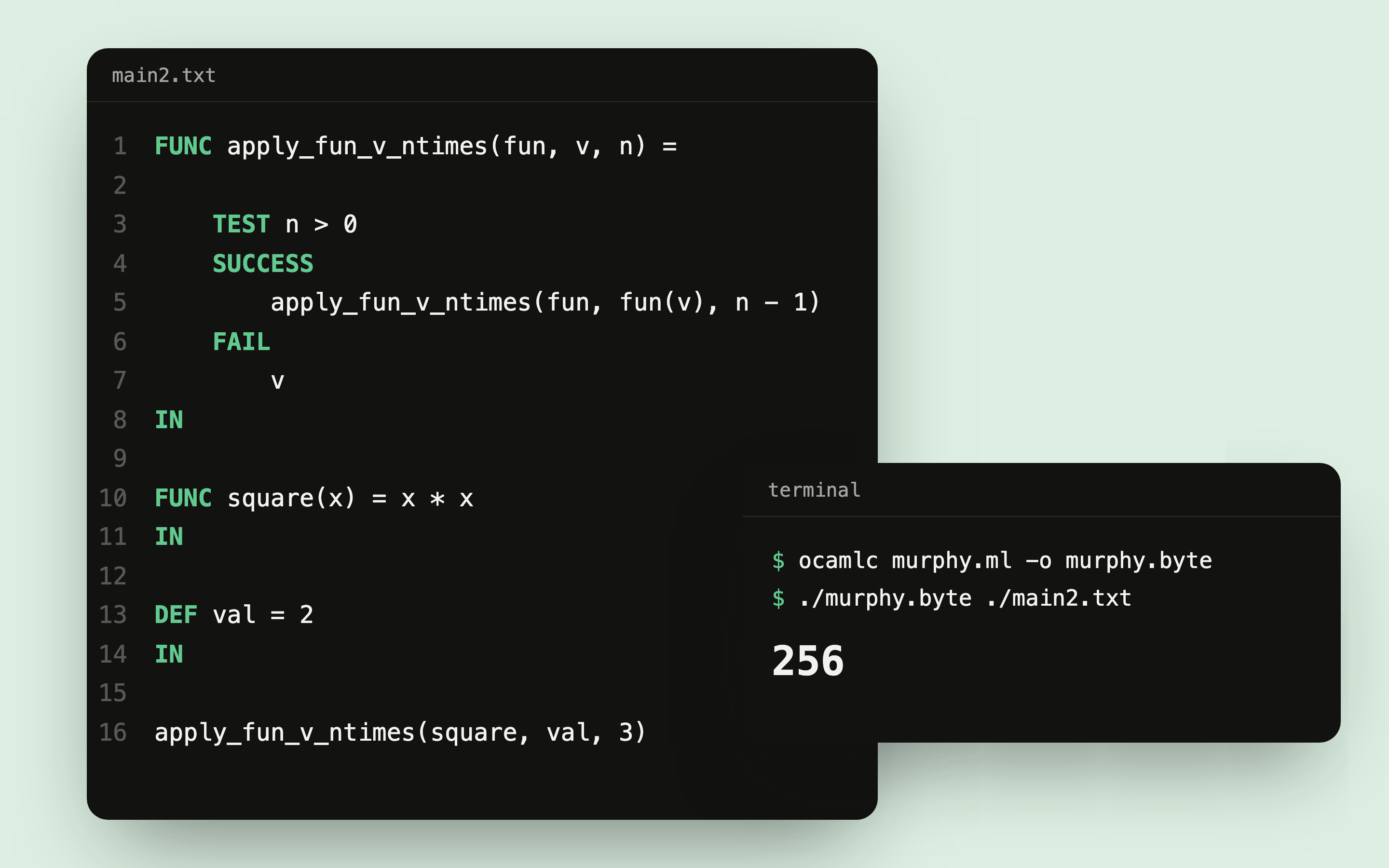
Write a program in Murphy and run it. The scanner, the parser and the interpreter are all in one OCaml file.
An interpreter feels like magic until you write one.
Every language you use has a scanner, a parser and an interpreter behind it. Murphy is a small one, built to see all three parts at work with nothing doing the hard parts for me.
Customer: me. I wanted to understand what happens between typing code and seeing it run, so I wrote the whole chain.
How it works
Scan the text
The source is cut into tokens: numbers, names, symbols and the capitalised keywords FUNC, TEST, SUCCESS, FAIL, DEF and IN.
square(2)IDEsquareLB(NUM2RB)Source text in, a list of tokens out. Parse it into a tree
Tokens are arranged by the grammar into a syntax tree, so that 2 + 3 * 4 multiplies before it adds.
Plus
├ Num 2
└ Mul
   ├ Num 3
   └ Num 4
14The tree for 2 + 3 * 4. The multiplication sits lower, so it runs first. Evaluate the tree
The interpreter walks the tree with an environment of variables and functions. Functions are values, so one can be passed to another.
2416256apply_fun_v_ntimes(square, 2, 3): square is passed in as a value and applied three times.
Small, on purpose
No dependencies
Plain OCaml. Compile it with ocamlc and run it.
Functions are values
A function can be passed as an argument and called inside another function.
Maths that does not crash
Dividing by zero gives PLUS_INFINITY, MINUS_INFINITY or NAN instead of an error.
Runs from the terminal
Write your program in a text file and pass it to the interpreter.
Built with
- OCaml
One OCaml file, about 760 lines. It works with integers only.